How Much Does Gym Management Software Cost? A 2026 Pricing Guide

"How much does gym management software cost?" is the right question — but the sticker price rarely tells the whole story. Between add-ons, per-location fees and payment processing, two platforms with the same headline price can cost very differently. Here's how pricing really works in 2026 and how to calculate your true monthly spend.
The common pricing models
Most gym software uses one — or a mix — of these:
Flat monthly tiers — Starter / Growth / Scale style plans with more features at each level
Per-location pricing — a base fee multiplied by each branch you run
Per-member or usage-based — cost rises with your active member count
Percentage of online sales — the platform takes a small cut of memberships or products sold through it
Payment-processing fees — a per-transaction percentage (often 2–4% + a fixed fee) on every card payment, usually separate from the subscription
The headline number you see is almost always just the subscription. Processing fees and add-ons sit on top.
Typical price ranges
These are broad industry ranges — always confirm current pricing directly, since many vendors change it or quote per gym:
Entry / small studio: roughly $50–$130 / month for core membership, billing and scheduling
Mid-tier (most gyms): roughly $130–$300 / month, often with a branded app and marketing tools
Enterprise / multi-location: typically custom-quoted, scaling with branches and members
A point worth noting: several well-known platforms don't publish pricing at all and require a sales call — which usually means quotes vary and upsells are likely. Most gyms end up spending several hundred dollars a month once their full software stack is added together.
Hidden costs to watch for
This is where budgets blow out:
Branded member app as an add-on — sometimes one of the priciest extras
SMS / email marketing — billed per message or as a separate module
Per-location fees — a "cheap" plan multiplied across branches
Payment processing % — small per-transaction, large over a year
Onboarding / setup fees — one-time, but can be significant
Contract lock-in — annual commitments that remove your flexibility
How to calculate your true monthly cost
Use this simple formula when comparing platforms:
(Base plan × number of locations) + add-ons you actually need + (processing % × expected monthly card volume) + (setup fee ÷ 12)
Run it for each shortlisted platform. The cheapest base plan often loses once add-ons and per-location fees are included.
Why transparent, all-in pricing matters
A platform that bundles the member app, POS and reporting into a clear plan — with no surprise per-feature charges — is usually both cheaper and easier to budget than a low base price plus a stack of extras. Predictable pricing also signals a vendor that isn't relying on upsells to make its margin.
What GYMTROX includes
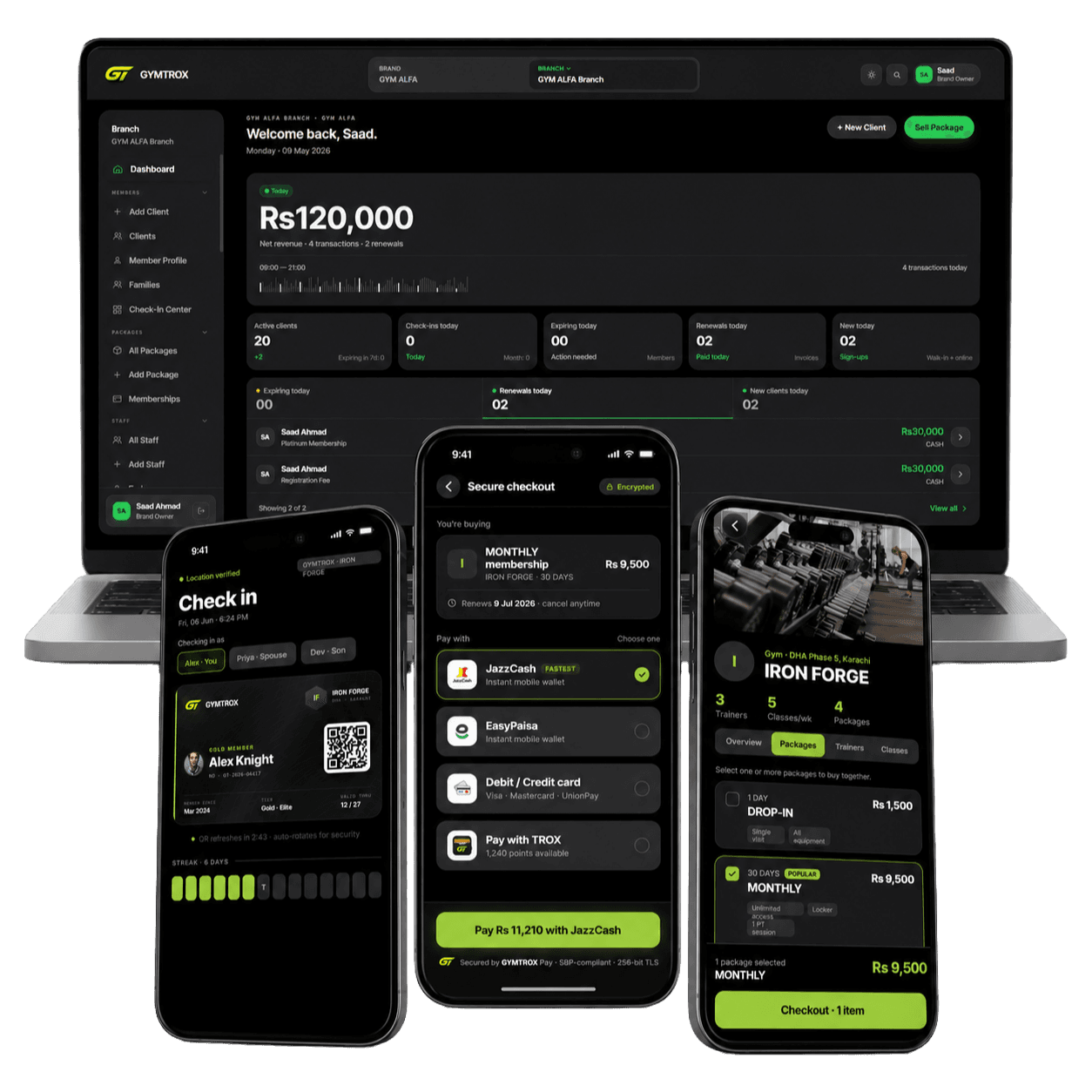
GYMTROX bundles the things competitors often charge extra for — the branded member app, retail and café POS, an engagement engine and reporting — into plans that scale with your branches, so there's no add-on stack to price out. Plans are tailored to your gym's size and number of locations.
The bottom line
Don't compare sticker prices — compare total cost: the base plan across all locations, the add-ons you truly need, processing fees and setup. Once you do, "all-in" platforms usually win on both price and simplicity.
Want a straight answer for your gym? Get a GYMTROX quote. And if you're still shortlisting tools, read our guide to the best gym management software in 2026.